Mobile Phone Technology
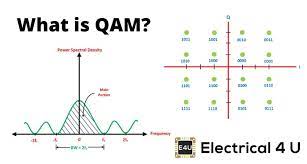
Quadrature Amplitude Modulation.
image ©Electrical 4UThe demand to deliver more bits on the carrier wave is always present. 8PSK delivers 3 bits (8 values), but this requires phase changes of 45 degrees. Extending this to 16PSK (22.5-degree phase changes) and 32PSK (11.25-degree phase changes) would be impossible.
In QAM, two carrier waves are transmitted: the 'I' wave, which is a sine wave; and the 'Q' wave, which is a cosine wave. These two waves are out of phase by 90 degrees.
In 16QAM, four bits are sent per wavelength. The first two bits are sent on the 'I' wave, and the other two bits on the 'Q' wave. To modulate the wave to send two bits per wavelength, 16QAM uses amplitude and phase shift keying. There are two possible amplitudes, and the wave can have a phase shift of 0 or 180°.
Once the four bits have been split into two groups of two and modulated onto the waves, they are added together for transmission and then split apart by the receiver for simple decoding. In order to use 16PSK to send four bits, the receiver would need to detect phase changes of 22.5 degrees. However, QAM decoding only has to differentiate between two amplitudes and a 180-degree phase shift, which is much easier to achieve without error.
To transmit more bits per wave, we can use 64QAM, which requires six bits split into two groups of three, again using a 180-degree phase difference and four different amplitudes. 64-QAM is used in 4G LTE-Advanced/5G, with the potential to extend to 256-QAM (8 bits). All of this is designed to transmit more error-free bits per carrier wave. However, as QAM includes amplitude modulation, signal amplification needs to be carried out using a linear amplifier, which consumes more power and therefore has a negative impact on mobile phones.
deepl.com [AI] has been used to improve the text in this description
We may have started to use our mobile phones to make phone calls but now these devices are key to our modern society. We use our mobile phones for directions in a strange city; to access our money through our banking and credit card apps; for tickets to travel whether that is bus, train or air; to watch videos; to take images and buy stuff.
But how does mobile phone technology work? mobilephonetechnology.co.uk seeks to provide information about the technology behind the mobile phone in order to aid understanding and promote more realistic discussions about the technology. Understanding some of the basics of mobile phone technology will help explain how things work and what can and cannot be done with mobile phone technology.
mobilephonetechnology.co.uk is a FREE online resource. Have you found it interesting? You can say thank you and buy me a coffee here. Thank you very much.
w : mobilephonetechnology.co.uk
e :
 Blog
© mobilephonetechnology.co.uk all rights reserved 2017-2026